ul. Podchorążych 2, 30-084 Kraków.
tel.: (+48 12) 662 6301;
fax: (+48 12) 637 2243;
Obs. tel.: (+48) 502 113714
Obserwatorium Astronomiczne na Suhorze
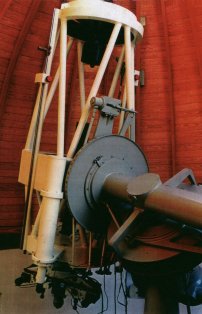
Teleskop 60cm na Suhorze

Chmury

Opady

Niebo
Temperatura
3.4 °C
Wilgotność
90%
Wiatr
1.6 km/h
Ciśnienie
1025.5 hPa

Księżyc
 Najnowsze prace na astro-ph:
›
Resolving the heart of the Wolf-Rayet binary Apep with ALMA ›
Discovery of eclipses in the cataclysmic variable MASTER OT J232100.42+494614.0 ›
Resolving the AGN Feeding and Feedback Cycle with ALMA2040 ›
Pathfinder results for populations of planet-forming discs with SKA ›
The environments forming stellar and planetary systems ›
Observational Signatures of Kerr Black Hole Lensing ›
Hidden Disruption in Milky Way-like Satellite Galaxy Populations ›
The bar-driven central complex of NGC 6946: A panchromatic and spatially resolved view of its star formation history and interstellar medium ›
Four Which I Knew Not: The Hexadecapole Nearly Cancels the Octupole in Librating Kozai-Lidov Cycles ›
Contrasting geometries of kiloparsec-scale stellar flows associated with giant Galactic cavities ›
Let Sleeping Stars Li: Mapping Turnoff Lithium, the Lithium Dip, & Testing Standard Model Predictions in GALAH DR4 Subgiants ›
An ALMA view on molecular complexity: water, methanol, and methyl formate in the HD 100546 and IRS 48 disks ›
Combining Rubin and Roman photometry and its implications for photometric redshift estimation ›
Searching for Dwarf Novae in 47 Tucanae ›
The Magnetized Universe: From planet-forming disks to the high-redshift universe ›
The LSST Science Pipelines Software: Optical Survey Pipeline Reduction and Analysis Environment ›
The Occurrence of Circumbinary Planets Around TESS M-dwarf Eclipsing Binaries ›
Primordial Power Spectrum from the Lensed CMB Temperature Spectrum using Iterative Delensing and Fourier Denoising ›
Sparking Dynamic, Relativistic Magnetic Reconnection in a Twisted Flux Tube ›
The transformative power of ALMA2040 for mm-VLBI ›
Double Trouble: How Unresolved Spectroscopic Binary Stars Skew GALAH DR4 Stellar Parameters ›
A New AI/ML Based Image Reconstruction Technique for Hard X-ray Coded Aperture Imagers ›
Multi-modal transmission forecasting for the Vera C. Rubin Observatory ›
Functional Analysis of Widefield Radio Interferometry ›
Dust in Galaxies at $z=10-15$: Attenuation and Re-emission Predictions from the FirstLight Simulations ›
A Multiwavelength View of SPLUS J102139.31-282247.5: an X-ray Luminous and Eclipsing Dwarf Nova ›
Gaia in Technicolor. I. A Simple Variability-Encoded Color-Magnitude Diagram ›
A Unified Solution to the Low-Mass X-ray Binary Diversity Puzzle: Saturated Magnetic Braking Coupled with Irradiation-Driven Winds ›
Analytic and numerical study of dark matter halos in the Horndeski theory ›
MIDSSAR: MId Dispersion Spectrograph for Stellar Activity Research ›
$\texttt{GASTRO-BH}$: Effects of a Central Black Hole in GSE-like Dwarf-galaxy Mergers Around Milky Way-like Hosts ›
On the foundations of anthropic reasoning: Implications for life across the universe ›
The START mission: Probing the 2029 Apophis Flyby via a Low-Cost Geocentric SmallSat ›
$N$-body simulations of the open cluster M67 -- I: global cluster properties ›
How bright can a galaxy be? Extreme value predictions for high-redshift survey observables ›
Gamma-ray calorimetry of Seyfert winds ›
What can a uniform reflection pipeline establish about supermassive black hole spin? An audit and a corrected analysis of 57 AGN with XMM and NuSTAR ›
Maximal efficiency of geometric beaming and polarization of highly super-Eddington X-ray sources ›
Seeing Through the RFI Mask: DT-FISTA Inpainting of Pulsar Dynamic Spectra via Fourier Sparsity ›
Extended J-band spectroscopy of red supergiants: parameter identifiability and metallicity robustness ›
Ranking Prompt--Plateau Correlations in Gamma-Ray Bursts with Symbolic Regression ›
Numerical study of multiple scattering intensities obtained from dust grains of different sizes and compositions in an impact-induced ejecta curtain ›
A new submillimeter Class I methanol maser at 345.903 GHz near the massive protostar S255IR NIRS3 ›
Relations between optical spectral parameters and the (far-)infrared continuum in Type~1 active galactic nuclei ›
Understanding sub-arcsecond scale radio sources and space weather with the SKA-Low using interplanetary scintillation ›
The coordinated radio and infrared survey for high-mass star formation - VI. Higher-resolution follow-up of point-like northern ultra-compact H II regions ›
The GAGE survey. I. Deep multi-band stellar variability characterization and automated classification toward Baade's window ›
Milky Way Near Twins (MWNeTs). II. Applications of a Hierarchical Framework to NGC 3521, NGC 2903, UGC 11487, and CGCG 047-026 ›
Foreground Groups and Host-Galaxy Geometry in the Dispersion-Measure Scatter of Fast Radio Bursts ›
The Dancing Bonfire: An Unusual Persistent X-ray Source in M81 Exhibiting Recurrent Luminous Flares ›
Inferring the delay time distribution of type Ia supernovae with CAALAM I: SED modelling choices and their effect on the delay time distribution ›
Comparing Infrared & X-ray-selected Active Galactic Nuclei host galaxy star formation rates to the galaxy main sequence ›
A blazar is a blazar is a blazar ... Comparing long-term varaibility properties of PKS 1510-089 and PKS 2155-304 ›
Broad Line Regions behind a Haze II: A Three-dimensional Electron-scattering Model of the Broad Br$\gamma$ Line in NGC 3783 ›
Three-dimensional spatial modelling of nuclear de-excitation lines ›
Prospects for Simultaneously Detecting Long and Short Duration Gravitational Waves from Pulsar Glitches with Current and Future Detectors ›
Exploring Cosmic Rays from Gravity-Limited Acceleration at Supermassive Black Holes ›
Impact of neutron captures on the r-process: I. Propagation of statistical model uncertainties ›
Topological Defects in Cosmic Shear ›
A Neural Network - Based Tool for Rapid Orbital Solution of Contact Binary Systems ›
SN 2025wiu: A Type Ib Supernova with Post-Peak Optical Rebrightening ›
ExHaLe-jet: Modeling blazar jets with an extended hadro-leptonic radiation code ›
Isomer-resolved ion-molecule reaction kinetics of HCO+ and HOC+ ›
Can coupled thawing quintessence reproduce DESI DR2? A test with two potentials ›
The Atmospheric Chemistry and Surface Interactions on Mars (ACSIOM) Workshop 2025 ›
Possible detection of Baryon Acoustic Oscillations imprinted in the HI sources from the FASHI catalog ›
Galaxy bias of radio AGN and star-forming galaxies from MIGHTEE and CMB lensing ›
A Hectospec Spectroscopic Census of Kinematic Members in the Orion Nebula Cluster ›
Survey of Orion Disks with ALMA (SODA) IV: Millimeter variability of protoplanetary disks ›
Does the inverse distance ladder rule out late-time solutions to the Hubble tension? A model-independent test using DES-Dovekie supernovae and DESI DR2 BAO ›
BRISK: An accelerated wide-field imager for radio astronomy ›
Characterizing the Martin Luther King Event: Sun to Earth Evolution of the January 19, 2026 Geomagnetic Storm ›
Foreground dependence of the 20 GeV Galactic halo gamma-ray excess and its proposed connection to the LUX-ZEPLIN event ›
A precessing AGN with S-shaped morphology discovered in MALS ›
Clustering of JWST LRDs. Implications for PBHs and other early-forming seeds ›
Gravitational Waves as a Probe of Multi-Fluid Cosmologies: General Formalism and the Case of Cosmological Stasis ›
Revisiting the Mass and Scale Dependence of the "Lensing is Low" Effect with DECADE ›
Detecting Exoplanetary Rings with Roman CGI Reflected Light Phase Curve Observations ›
Entering the Era of Circumplanetary Ring Detection with Direct Imaging ›
Flashing with colours: Photometric indicators of an early interaction in type II supernovae ›
Geometrical and Optical Design of the GUEST Laser-Ranged Test Masses for the Detection of Gravitational Waves in the $\mu$Hz range ›
Beyond Mergers: the Role of Metallicity in Forming a Reservoir of Massive and Detached Binary Black Hole Systems ›
Long-Lived Charge Trap Characterization for Rare-Event Searches with Skipper-CCDs ›
Star Light, Star Bright: Can Multimodal Models Parse an Astronomy Visual Question Answering Dataset Right? ›
Modeling extreme mass-ratio inspirals in astrophysical and dark-matter environments ›
No cosmic horizons from a strengthened higher-dimensional strong energy condition ›
Constraints on Decaying Dark Matter with $B=1$ from Fermi-LAT ›
Trapping of nanofabricated SiO$_2$ high-aspect-ratio discs in an optical lattice ›
Pair-exchange dynamics of magnetohydrodynamic turbulence ›
Native Geometry vs. Linear Recoverability: How Alignment Changes Platonic Scaling ›
Laboratory Characterization of a Ge-CCD Prototype for Future Near-Infrared Astronomical Instrumentation ›
Simulating dust collapse: the impact of gauge choices on primordial black hole formation ›
The metric-affine $\mathring{R}^2$ scalaron: parameter-free inflation ›
Andreev Beta Conversion and Bulk Viscosity in Superfluid Neutron-Star Matter ›
Principle of no paradoxical Universe ›
Hidden Sector Relic Abundances from an Effective Planck Mass ›
Learning without relearning physical symmetry: an SO(3)-equivariant convolutional network (CNN) on the sphere ›
ENFR: Evidence Networks with Flow-Matched References for Amortized Simulation-Based Model Inference ›
New catalog of distances to planetary nebulae based on Gaia parallaxes and statistical distances ›
Galaxy Luminosity Function of the Coma Cluster from Deep $u'-g'-r'$ Wendelstein Imaging Data ›
Hydrodynamic instabilities in long-term three-dimensional simulations of neutrino-driven supernovae of 13 red supergiant progenitors ›
Clustering effects on the Dark Siren determination of $H_0$: A simulation study ›
Self-resonance preheating in deformed attractor models: oscillon formation and evolution ›
A unified harmonic framework for dark siren cosmology ›
Revisiting Constraints on Primordial Curvature Power Spectrum from PBH Abundances ›
The Effect of Mass Loss and Convective Overshooting on the Pre-Collapse Structure, Composition, and Neutrino Emission of Red Supergiants ›
Charged-current neutrino opacity within the relativistic Hartree-Fock framework for astrophysical simulations of core-collapse supernovae and binary neutron star mergers ›
Can current models predict the local black hole merger rate? ›
Constraints with CMB lensing on dark matter decays to massive decay products ›
Cosmological constraints from the DESI DR1 Bispectrum Full-Shape and DR2 BAO ›
Differentiable design of the PIAA-ZWFS: a flexible wavefront sensor that approaches the fundamental limit ›
Transition from Diffusion to Drift-Dominated Cosmic Ray Transport and the Origin of the Knee ›
FRANZ: Framework for analytical one-zone blastwave dynamics ›
Gas Motions in Hydra-A: XRISM Constraints on ICM Kinematics Across Jet-Inflated Cavities ›
A Deep Look at the Ultra-Faint Milky Way Satellite Virgo III with Rubin Observatory Data Preview 2 ›
An ALMA study of hub-filament systems II.Quiescent filaments converging towards highly dynamic hubs ›
An "inside-out" approach to modeling supermassive black hole binary inspiral ›
Bifrost spectral inversions: Fast non-LTE solar chromospheric diagnostics from 3D simulations ›
HURACAN: A comparison of stellar and interstellar proper motions inside L1688 ›
Constraints from big bang nucleosynthesis and cosmological observations on varying Higgs vacuum expectation value ›
IXPE observation of the new magnetar source EP J223759.5+531421 ›
Resistive alignment of a black-hole magnetosphere ›
The origin of the high heavy-element content of warm Jupiters ›
EMU detection of mysterious multiple component radio-continuum emission from nearby spiral Seyfert I type galaxy 'Sand-timer' (NGC 7213) ›
Constrain the Size of Broad Line Region in NGC 1068 Using Sub-millimeter Excess ›
Missed Detections and False Alarms in a CNN Technosignature Detector on Breakthrough Listen Data ›
Dark Matter in the Galaxy: Insights from the Dynamics of Stellar Streams ›
Chemical Demographics of Star-forming Regions ›
NeuralDMD: Interpretable Neural Representation of Dynamics from Sparse and Noisy Measurements ›
Scattered light noise due to dust particles contamination in the vacuum pipes of the Einstein Telescope ›
Chaotic Imprints in Gravitational Waves from Extreme-Mass-Ratio-Inspirals Embedded in Dark Matter Halo ›
Dark Photon mediated Inelastic Dark Matter in Cosmology, Astrophysics and Colliders ›
Thermodynamic Gravity with Non-Extensive Horizon Entropy and Topological Calibration ›
Cracking Gravitational Wave Multiple Ringdown Modes in Space ›
Path-Degenerate Quantum Interferometry for Loss Resilience in Gravitational-Wave Detectors ↓↑


 in English
 Wiadomości z astronet.pl